

Learn, Adapt, and Grow: Turning Challenges Into Success
 By Origin Websolutions
- Startup Growth
- Apr 20, 2026
- 6 minutes read
- 1,367 Views
Learn how embracing failure can help businesses overcome challenges, improve decision-making, encourage innovation, build resilience, and turn setbacks into valuable opportunities for growth.
“ Successful businesses are not those that never fail, but those that learn from failure and keep moving forward ”
Challenges are an unavoidable part of business and personal growth. Every successful business, entrepreneur, and professional faces setbacks at some point. A campaign may fail, a product may not perform as expected, a project may miss its target, or a carefully planned strategy may produce disappointing results. While failure can be frustrating, it can also become one of the most valuable sources of learning.
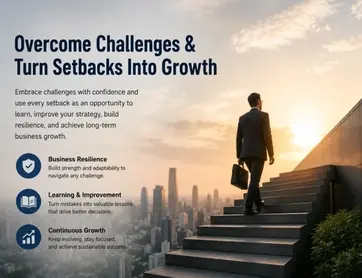
Overcome Challenges & Turn Setbacks Into Growth
Embrace challenges with confidence and use every setback as an opportunity to learn, improve your strategy, build resilience, and achieve long-term business growth.
- Business Resilience
- Continuous Growth
Embracing failure as a learning opportunity means changing the way we look at setbacks. Instead of seeing failure as the end of an effort, businesses can treat it as feedback that reveals what needs to change. This mindset can encourage innovation, improve decision-making, and help organizations become stronger and more adaptable.
Why Challenges Are Important for Growth
Challenges often push businesses outside their comfort zones. When everything works perfectly, there may be little reason to question existing processes or search for better solutions.
Difficult situations encourage businesses to examine their strategies, identify weaknesses, and find new approaches. A failed marketing campaign, for example, may reveal that the message did not connect with the target audience. Instead of simply abandoning marketing efforts, the business can use that information to improve future campaigns.
Challenges therefore provide an opportunity to discover what works, what does not, and what can be improved.
Change the Way You Think About Failure
One of the most important steps in overcoming challenges is developing a positive attitude toward failure. This does not mean ignoring mistakes or pretending that setbacks are unimportant. It means using them constructively.
Instead of asking, “Why did this happen to us?”, ask:
- What went wrong?
- What can we learn from the experience?
- Which decisions contributed to the result?
- What could we do differently next time?
- What information did this experience provide?
These questions turn failure into a learning process rather than a source of discouragement.
Learn From Mistakes
A mistake becomes valuable when it produces useful knowledge. Businesses should take time to understand why something failed instead of immediately moving on to the next task.
For example, if a new service receives little customer interest, the business can examine its pricing, positioning, communication, customer research, and sales process. Perhaps the service solves a problem customers do not consider urgent, or perhaps the business has not explained its benefits clearly.
Identifying the underlying reason for failure allows the company to make informed changes rather than repeating the same mistake.
Use Failure to Improve Business Strategy
Failure can provide valuable information for business strategy and decision-making. When a plan does not deliver the expected results, businesses can review their assumptions and make adjustments.
This process may involve analyzing customer feedback, website performance, sales data, advertising results, or operational processes. Data can help transform a disappointing outcome into actionable information.
A business that regularly evaluates its results can become more flexible and responsive to changing customer needs.
Encourage Innovation and Experimentation
Innovation often requires experimentation. Not every new idea will succeed, and businesses that are afraid of failure may avoid taking reasonable risks altogether.
Testing new ideas on a smaller scale can make experimentation more manageable. Businesses can launch a limited campaign, test a new product feature, try different content formats, or experiment with new marketing messages.
The results can then be analyzed before making a larger investment.
This approach allows companies to learn quickly while reducing unnecessary risk.
Build Resilience
Resilience is the ability to recover from setbacks and continue moving forward. It is an important quality for businesses operating in competitive and constantly changing markets.
Resilient teams do not expect every project to succeed. Instead, they understand that setbacks are part of the process and focus on finding solutions.
Building resilience requires patience, communication, realistic expectations, and a willingness to adapt. Leaders can support this environment by encouraging employees to discuss problems openly and focus on solutions rather than blame.
Turn Customer Feedback Into an Opportunity
Customers can provide some of the most useful information about what a business needs to improve. Negative reviews, complaints, returns, and unanswered questions may initially appear to be problems, but they can reveal areas that require attention.
Businesses should listen carefully to customer feedback and look for recurring patterns. If several customers experience the same problem, it may indicate an issue with the product, service, website, communication, or customer support.
Responding professionally to feedback can also demonstrate that the business values its customers and is willing to improve.
Learn From Successful Businesses
Businesses can also learn from the challenges faced by other companies. Case studies, industry research, business interviews, and professional communities can provide insights into strategies that worked and mistakes that others encountered.
However, businesses should avoid copying another company's approach without considering their own audience, resources, industry, and goals. The most useful lessons should be adapted to fit the organization's unique circumstances.
Create a Culture That Values Learning
A strong learning culture can help organizations respond to failure more effectively. Employees should feel comfortable sharing ideas, asking questions, and discussing mistakes without unnecessary fear of blame.
After completing an important project, teams can conduct a simple review to identify what went well, what did not, and what should change in the future.
These regular discussions can turn individual experiences into knowledge that benefits the entire organization.
Keep Moving Forward
Learning from failure is valuable only when it leads to action. After identifying what went wrong, create a practical plan for improvement.
Set clear objectives, make necessary changes, test the new approach, and measure the results. The goal is not to avoid every future failure but to become better prepared to handle challenges.
Progress rarely happens through one perfect decision. It is often the result of repeated learning, testing, adapting, and improving.
Conclusion
Overcoming challenges requires resilience, flexibility, and a willingness to learn from failure. Setbacks can be difficult, but they can also reveal valuable information about customers, strategies, processes, and decision-making.
Businesses that treat failure as feedback rather than defeat can use difficult experiences to improve their performance and become more adaptable. By analyzing mistakes, listening to customers, encouraging experimentation, and creating a culture of continuous learning, organizations can turn challenges into opportunities for growth.
Standing out from the crowd is not always about achieving success without mistakes. Sometimes, it is about how effectively you respond when things do not go according to plan. The ability to learn, adapt, and move forward can become one of the strongest advantages a business can develop.
Origin Websolutions
Origin Websolutions is a team of web development and digital marketing professionals sharing practical insights on SEO, digital marketing, website development, content strategy, and online business growth. The team simplifies complex digital topics and provides useful tips, trends, and strategies to help businesses strengthen their online presence and grow.