

Google Algorithm Updates: How to Protect Your Website Rankings and Grow Online
 By Origin Websolutions
- Business Technology
- Apr 20, 2026
- 8 minutes read
- 955 Views
Learn how Google algorithm updates can affect website rankings and discover practical SEO strategies to protect organic visibility, improve website performance, and support sustainable online growth.
“ SEO success is not about chasing every update; it is about continuously improving value, trust, and user experience ”
Google Search is constantly evolving, and businesses that depend on organic traffic need to stay prepared. A website that ranks well today may experience changes in visibility when Google's ranking systems are updated, competitors publish stronger content, or user expectations change. For a digital web agency, understanding these changes is essential for helping clients build websites that remain useful, technically sound, and competitive over time.
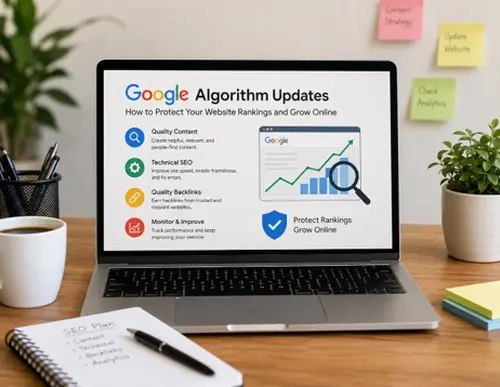
Protect Your Rankings & Grow Online
Strengthen your website with smart SEO strategies, helpful content, and technical optimization designed to protect search visibility, improve performance, and support sustainable online growth.
- SEO Growth
- Technical Optimization
- 100% Secure
Google makes significant broad core updates several times a year, while its ranking systems are also improved continuously through smaller changes. Google says these updates are designed to improve the quality and usefulness of Search results rather than target individual websites.
The good news is that businesses do not need to chase every algorithm change. A better approach is to build a strong SEO foundation based on helpful content, excellent user experience, technical accessibility, and continuous improvement.
What Are Google Algorithm Updates?
Google's ranking systems use many signals and automated systems to determine which pages are most relevant and useful for a particular search. Google regularly improves these systems through testing and evaluation.
Some changes are broad core updates, while others affect particular search experiences or systems. A ranking change does not necessarily mean that a website has received a penalty.
For businesses, the important lesson is simple: SEO is an ongoing process, not a one-time project.
Why Algorithm Updates Matter to Businesses
Organic search can be an important source of customers, leads, and brand visibility. If important pages lose rankings, a business may see changes in impressions, clicks, and conversions.
However, ranking fluctuations are normal. Google explains that Search results are dynamic because user expectations and the wider web continue to change.
Instead of reacting immediately to every ranking movement, website owners should look for sustained patterns and analyze the data carefully.
Focus on Helpful, People-First Content
One of the strongest ways to prepare for Google's evolving systems is to create content for people rather than search engines.
Google's guidance emphasizes helpful, reliable, original, people-first content. It recommends creating material that provides substantial value, demonstrates knowledge, and gives readers a satisfying experience.
For a digital web agency, this means helping clients create content that genuinely answers customer questions.
Instead of publishing dozens of thin articles simply to target keywords, create fewer but more useful resources that provide practical answers, examples, original insights, and clear explanations.
Avoid Keyword Stuffing
Keywords remain useful because they help search engines and users understand what a page is about. However, repeating the same keyword unnaturally can make content difficult to read and may create a poor user experience.
Use relevant terms naturally throughout headings, paragraphs, image descriptions, and links where appropriate.
Google's Search Essentials recommends using words that people would use to find your content, while its guidance also emphasizes avoiding search-engine-first content.
The priority should always be clarity and usefulness.
Strengthen Your Website's Technical SEO
Great content needs a technically accessible website. Google recommends meeting its technical requirements so that pages can be discovered, crawled, indexed, and considered for Search.
A digital web agency should regularly review:
- Crawlability
- Indexability
- Internal links
- Mobile usability
- Page performance
- Broken links
- Redirects
- HTTPS
- XML sitemaps
- Robots.txt
- Structured data
- Canonical URLs
Technical SEO does not guarantee high rankings, but technical problems can prevent valuable content from being properly discovered or understood.
Improve the User Experience
A visitor should be able to understand and navigate a website easily. A page that is difficult to use can discourage visitors even if the content itself is useful.
Focus on readable typography, intuitive navigation, mobile-friendly layouts, clear calls to action, fast-loading pages, and a clean design.
Google's guidance also emphasizes providing a good overall page experience rather than focusing on only one technical metric.
For web agencies, this is an important opportunity to combine web design, development, and SEO into one strategy.
Demonstrate Experience and Trust
Businesses should make it clear who created their content and why readers should trust it. Google encourages creators to consider who created the content, how it was produced, and why it exists.
Useful trust signals can include:
- Author information
- Company information
- Contact details
- Original research
- Real examples
- Relevant experience
- Reliable references
- Clear service information
For business websites, authentic information can make content more useful while strengthening credibility with potential customers.
Monitor Google Search Console
Google Search Console is an important tool for understanding how a website performs in Google Search.
Agencies can use it to monitor clicks, impressions, queries, indexing issues, and changes in search visibility.
If traffic falls after an algorithm update, do not immediately rewrite or delete everything. First identify which pages and search queries were affected and compare their performance before and after the update.
Google specifically recommends reviewing affected pages and queries and assessing whether the decline is small or significant before taking major action.
Do Not Make Panic Changes
A ranking decline does not automatically mean something is wrong with your website.
If a page moves from position two to position four, for example, Google advises that drastic changes may not be necessary. A larger and sustained decline deserves a deeper review.
Avoid changing titles, removing content, rebuilding pages, or deleting entire sections simply because rankings moved for a few days.
Analyze the evidence first.
Update Content With a Purpose
Content should be reviewed when information becomes outdated, incomplete, or inaccurate. Updating an article can improve its usefulness when the update genuinely adds value.
However, Google specifically warns against changing dates or adding large amounts of content simply to make a website appear fresh.
A better approach is to review important pages regularly and update them when there is something meaningful to improve.
Diversify Your Digital Marketing Strategy
SEO is valuable, but businesses should avoid depending entirely on one traffic source.
Digital agencies can help clients build a broader strategy that includes:
- Organic search
- Social media
- Email marketing
- Paid advertising
- Direct traffic
- Referral traffic
- Content marketing
- Brand building
A diversified strategy can make a business less vulnerable when search visibility fluctuates.
Think Long Term
Google's systems are continually evolving, so there is no permanent formula for maintaining a specific ranking position.
The strongest strategy is to build a website that remains valuable even as algorithms change.
That means investing in original content, strong technical foundations, excellent user experience, genuine expertise, and continuous improvement.
Google notes that improvements may sometimes take days to show an effect, while broader changes can take several months as systems learn and confirm improvements across a site.
Conclusion
Google algorithm updates are a normal part of modern SEO. Instead of trying to predict every change, businesses should focus on creating websites that genuinely help people.
For digital web agencies, this means combining technical SEO, high-quality content, user-focused design, analytics, and continuous optimization. Monitoring performance through reliable data can help identify meaningful changes without encouraging unnecessary reactions.
The businesses that stand out from the crowd are not necessarily those that chase every algorithm update. They are the ones that consistently provide valuable information, excellent experiences, trustworthy services, and websites built for real users.
FAQ – Google Algorithm Updates
Find quick answers to common questions about Google algorithm updates, SEO rankings, website traffic, content quality, and practical strategies for protecting your online visibility.
1. What is a Google algorithm update?
A Google algorithm update is a change or improvement to Google's automated Search ranking systems that can affect how pages are evaluated and displayed in search results.
2. How often does Google update its algorithm?
Google continuously makes changes to its ranking systems, including significant core updates several times a year and smaller ongoing improvements.
3. Can a Google algorithm update lower my website rankings?
Yes. Rankings can rise or fall as Google's systems change, competitors improve their pages, and user expectations evolve. A ranking decline does not automatically mean your site has been penalized.
4. How can I protect my website from Google updates?
Focus on helpful, reliable, people-first content, strong technical SEO, good page experience, clear website structure, and genuine value for visitors.
5. Should I change my website after every Google update?
No. Avoid making sudden or drastic changes based on short-term ranking fluctuations. Analyze Search Console data and identify sustained changes before deciding what needs improvement.
6. Is keyword stuffing still effective for SEO?
No. Keywords should be used naturally and appropriately. Google's guidance emphasizes useful content rather than content created primarily to manipulate rankings.
7. Does technical SEO matter after an algorithm update?
Yes. Technical SEO helps Google access, crawl, understand, and index your website. Google's Search Essentials identifies technical requirements as a fundamental part of Search visibility.
8. How long does it take to recover from a ranking drop?
There is no fixed recovery period. Google says some improvements may show effects within days, while broader site-level improvements can take several months to be recognized.
9. Should I delete low-performing content?
Not automatically. First determine whether the content is genuinely unhelpful, outdated, redundant, or lacking value. Google recommends assessing content carefully rather than deleting pages simply because they receive less traffic.
10. Can a digital web agency help with Google algorithm updates?
Yes. A digital web agency can audit technical SEO, analyze Search Console data, improve content, enhance website performance, strengthen internal linking, and develop a long-term SEO strategy focused on users and sustainable growth.
Origin Websolutions
Origin Websolutions is a team of web development and digital marketing professionals sharing practical insights on SEO, digital marketing, website development, content strategy, and online business growth. The team simplifies complex digital topics and provides useful tips, trends, and strategies to help businesses strengthen their online presence and grow.