

Conversion Rate Optimization: Turning Website Visitors Into Loyal Customers
 By Origin Websolutions
- Business Technology
- Apr 20, 2026
- 9 minutes read
- 2,480 Views
Discover how Conversion Rate Optimization can transform your website into a powerful business tool by improving user experience, building trust, simplifying customer journeys, and turning more visitors into loyal customers.
“ A successful website does not simply attract visitors; it guides them toward meaningful action and gives them a reason to come back ”
Getting visitors to your website is only the first step in building a successful online business. The real challenge is encouraging those visitors to take meaningful actions—whether that means making a purchase, submitting a form, requesting a quote, booking a consultation, or becoming a repeat customer. This is where Conversion Rate Optimization (CRO) becomes an important part of a digital web agency's strategy.
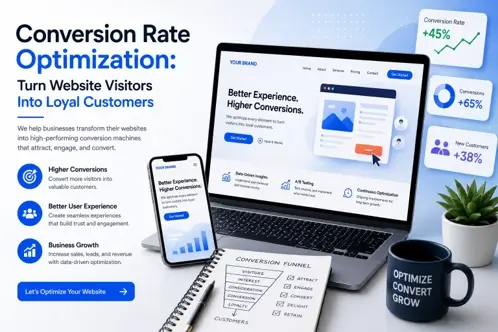
Turn Visitors Into Loyal Customers
Optimize your website with conversion-focused strategies that improve user experience, build trust, increase engagement, and turn more visitors into loyal customers.
- Conversion Optimization
- User Experience
- Customer Growth
A well-optimized website does not simply attract traffic. It creates a clear, trustworthy, and convenient experience that helps visitors move from interest to action. By combining thoughtful web design, persuasive content, technical performance, analytics, and user experience, businesses can turn more of their existing traffic into valuable customers.
What Is Conversion Rate Optimization?
Conversion Rate Optimization is the process of improving a website or landing page to increase the percentage of visitors who complete a desired action.
A conversion could be:
- Purchasing a product
- Filling out a contact form
- Requesting a quotation
- Booking a consultation
- Signing up for a newsletter
- Downloading a resource
- Creating an account
For example, if 1,000 people visit a landing page and 50 complete a desired action, the conversion rate is 5%.
CRO focuses on understanding why some visitors convert while others leave and then improving the experience based on evidence.
Why CRO Matters for Digital Businesses
Businesses often invest heavily in SEO, social media, paid advertising, and content marketing to attract visitors. However, generating more traffic is not always the most efficient way to increase results.
If a website receives 10,000 visitors but only a small percentage take action, improving the conversion rate can create significant value without requiring the same increase in traffic.
This makes CRO especially useful for digital web agencies working with businesses that already have a steady flow of visitors.
Understand Your Audience First
Effective conversion optimization begins with understanding the people visiting your website.
A business should know what customers are looking for, what problems they want to solve, what questions they have, and what concerns might prevent them from taking action.
Customer research can include website analytics, surveys, interviews, customer reviews, support questions, and sales-team feedback.
The better a business understands its audience, the easier it becomes to create relevant messaging and useful website experiences.
Create Clear and Compelling Headlines
Visitors often decide very quickly whether a webpage appears relevant to them. A clear headline can immediately communicate what the business offers and why it matters.
Instead of using vague statements, explain the specific benefit.
For example, a web agency could use a headline such as “Build a Faster Website That Attracts More Customers” instead of a generic phrase like “Welcome to Our Agency.”
A strong headline should be easy to understand and aligned with the visitor's expectations.
Make Calls to Action Easy to Find
A website should make the next step obvious.
Calls to action such as “Get a Free Quote,” “Book a Consultation,” “Start Your Project,” or “Contact Us” can guide visitors toward conversion.
The wording should communicate what will happen after clicking. Buttons should also be visually distinguishable and positioned naturally within the page.
Avoid overwhelming visitors with too many competing actions. Focus each page on its primary objective.
Build Trust Before Asking for Action
Visitors may hesitate if they are uncertain about a company's credibility.
Trust can be strengthened through:
- Customer testimonials
- Case studies
- Reviews
- Client logos
- Industry experience
- Clear contact information
- Secure payment options
- Transparent pricing where appropriate
- Professional design
- Helpful and accurate content
For a digital web agency, showcasing successful projects and explaining the results achieved for clients can help potential customers make more confident decisions.
Improve Website Speed
Performance plays an important role in user experience. A slow website can create frustration and cause visitors to leave before they even explore the offer.
Digital agencies should optimize images, reduce unnecessary scripts, improve caching, use efficient code, and select appropriate hosting and delivery solutions.
Performance optimization should be considered during development rather than treated as an afterthought.
Optimize for Mobile Visitors
A conversion-focused website must work effectively on smartphones.
Forms should be easy to complete, buttons should be easy to tap, content should remain readable, and important information should be accessible without excessive scrolling or complicated navigation.
A desktop design that looks excellent but performs poorly on mobile can lose valuable opportunities.
Simplify Forms
Long or complicated forms can discourage visitors from completing them.
If a business only needs a name, email address, and basic project information to begin a conversation, there may be little reason to request dozens of fields.
Start with the information that is genuinely necessary. Additional details can often be collected later during the sales process.
Simple forms reduce friction and can make the conversion process more convenient.
Use Landing Pages Strategically
Landing pages are designed around specific campaigns, audiences, products, or services.
For example, a digital agency running an advertising campaign for SEO services could create a dedicated SEO landing page rather than sending visitors to a general homepage.
A focused landing page can align the headline, offer, supporting content, testimonials, and call to action around one specific objective.
Use Analytics to Find Problems
CRO should be based on data rather than assumptions.
Analytics can help identify:
- High-traffic pages
- Pages with high exit rates
- Popular conversion paths
- Form abandonment
- Device differences
- Traffic sources
- Conversion trends
This information can reveal where visitors encounter problems.
For example, if a landing page receives significant traffic but very few inquiries, the business can investigate whether the messaging, offer, page structure, trust signals, or call to action needs improvement.
Test Before Making Major Changes
Testing allows businesses to compare different versions of a webpage or element.
A business might test two headlines, button descriptions, layouts, images, or forms to determine which version performs better.
However, tests should have a clear purpose. Changing several major elements simultaneously can make it difficult to understand which change produced the result.
A structured testing process helps businesses make more informed decisions.
Personalize the Customer Journey
Different visitors may have different needs. A first-time visitor may need educational information, while someone returning to the website may already understand the product and be closer to making a decision.
Businesses can use audience insights to create more relevant content and experiences.
Personalization should be useful and respectful rather than intrusive. The objective is to make the customer journey easier.
Turn Conversions Into Relationships
CRO should not end when someone completes a form or makes a purchase.
A successful business should think about what happens next.
Follow-up emails, helpful onboarding, customer support, useful resources, loyalty programs, and personalized communication can help turn a first conversion into a long-term relationship.
The ultimate goal is not simply more conversions. It is creating customers who trust the business and are willing to return.
Standing Out From the Crowd
Many websites compete for the same customers. A business can stand out by creating an experience that is clear, useful, fast, trustworthy, and genuinely focused on customer needs.
A digital web agency can bring these elements together through conversion-focused design, technical optimization, content strategy, analytics, and continuous testing.
The strongest websites do not force visitors to act. They remove uncertainty and make the right action feel simple.
Conclusion
Conversion Rate Optimization is about making every website visit more valuable. Instead of focusing only on attracting more traffic, businesses can improve the experience they provide to the people who are already visiting.
By understanding customers, improving website speed, simplifying navigation and forms, strengthening trust, creating clear calls to action, and using data to guide decisions, businesses can increase conversions and build stronger customer relationships.
For a digital web agency, CRO provides an opportunity to combine design, development, SEO, analytics, and marketing into one growth-focused strategy. When every part of the website works together, visitors are more likely to engage, convert, and eventually become loyal customers.
FAQ – Conversion Rate Optimization
Find quick answers to common questions about CRO, website conversions, user experience, landing pages, website performance, and strategies for turning more visitors into loyal customers.
The strongest digital experiences do not simply attract attention—they create confidence, remove friction, and make it easy for customers to take the next step.
1. What is Conversion Rate Optimization?
Conversion Rate Optimization is the process of improving a website to encourage a higher percentage of visitors to complete desired actions.
2. Why is CRO important for a business website?
CRO can help businesses get more value from their existing website traffic by making the customer journey clearer, easier, and more effective.
3. What counts as a website conversion?
A conversion can be a purchase, contact form submission, consultation booking, phone call, newsletter signup, download, or another valuable action.
4. How does CRO improve user experience?
CRO identifies obstacles that may prevent visitors from taking action and improves navigation, content, forms, calls to action, speed, and overall usability.
5. How can website design affect conversions?
Clear layouts, readable content, professional visuals, intuitive navigation, and strategically placed calls to action can make it easier for visitors to understand a business and take action.
6. Does website speed affect conversion rates?
Website speed can influence the user experience. Faster, smoother pages can make it easier for visitors to browse content and interact with important website elements.
7. Why are landing pages important for CRO?
Landing pages can focus visitors on a specific product, service, campaign, or action, making them useful for generating leads and increasing conversions.
8. How can businesses improve mobile conversions?
Businesses can improve mobile conversions by using responsive design, readable text, simple forms, fast-loading pages, easy navigation, and touch-friendly buttons.
9. How do analytics help with CRO?
Analytics provide information about visitor behavior, traffic sources, popular pages, exits, and conversions, helping businesses make more informed optimization decisions.
10. Can a digital web agency provide CRO services?
Yes. A digital web agency can combine UX design, web development, analytics, content, SEO, performance optimization, and testing to create a conversion-focused website.
Origin Websolutions
Origin Websolutions is a team of web development and digital marketing professionals sharing practical insights on SEO, digital marketing, website development, content strategy, and online business growth. The team simplifies complex digital topics and provides useful tips, trends, and strategies to help businesses strengthen their online presence and grow.